
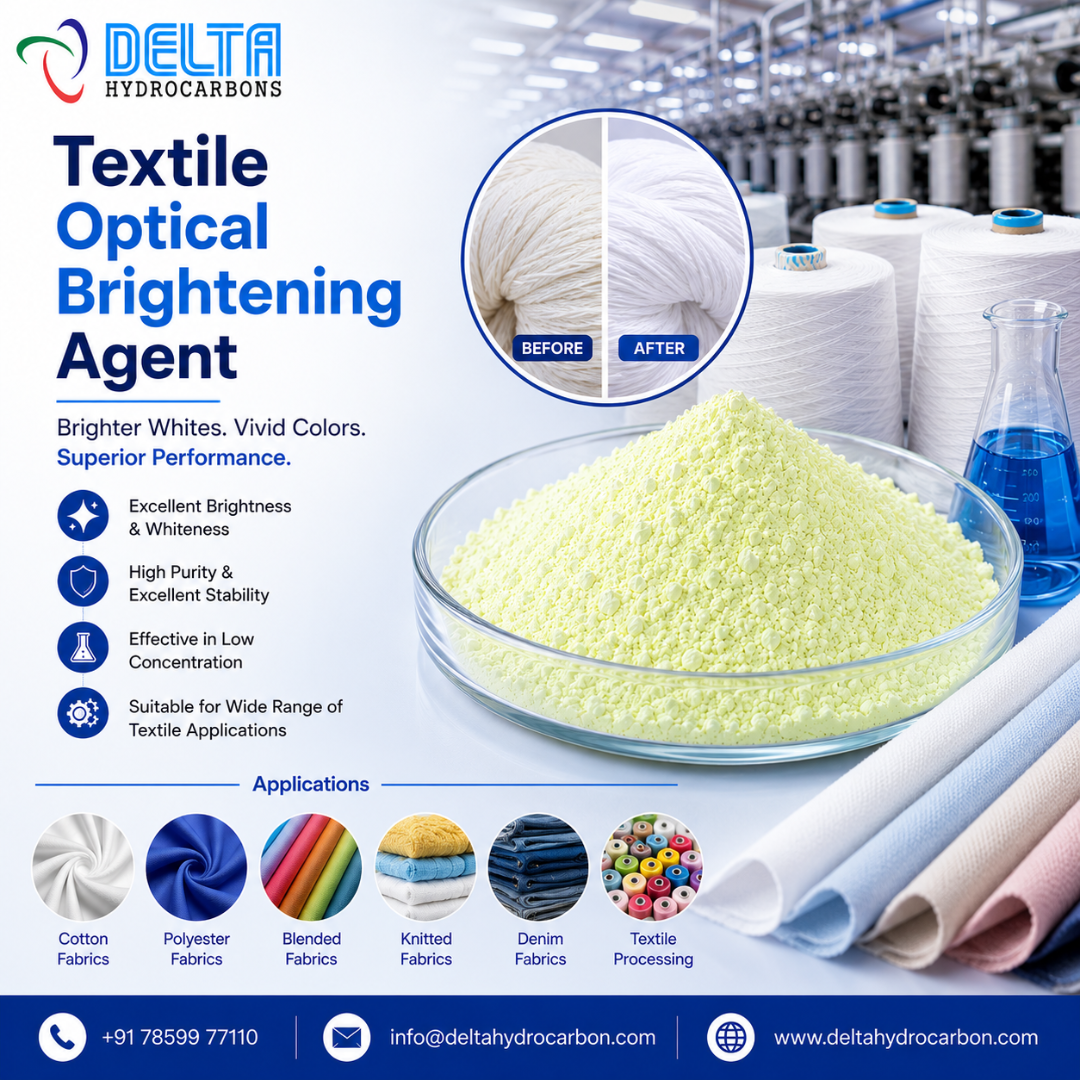
Textile Optical Brightening Agent – Delta Hydrocarbon
A bright, clean-looking fabric often creates a stronger first impression. In textile processing, even high-quality fibres can appear slightly dull or yellowish without the right finishing support. A suitable Textile Optical Brightening Agent helps improve the perceived whiteness, freshness, and visual appeal of fabrics. Delta Hydrocarbon provides practical brightening solutions for textile processors seeking dependable performance and application-focused guidance.
The right Textile Optical Brightening Agent works by absorbing ultraviolet light and releasing it as visible blue light. This fluorescent effect helps offset yellow tones and gives white or light-coloured fabrics a brighter appearance. It is widely used in cotton, polyester, viscose, nylon, blends, yarns, and finished garments, depending on the selected grade and process conditions.
What Is a Textile Optical Brightening Agent?
A Textile Optical Brightening Agent is a specialty chemical used during textile dyeing, washing, padding, exhaust, printing, or finishing processes to enhance visual brightness. It does not work like a conventional bleach. Instead, it produces an optical effect that makes the fabric appear whiter and more luminous under normal light.
A compatible Optical Brightening Agent should be selected based on fibre type, process temperature, pH level, equipment, and required durability. Different textile materials respond differently, so using a grade designed for the specific substrate is important for achieving consistent results.
Key Features for Textile Processing
The right brightening solution can support both product appearance and production consistency. Common features include:
- Improved apparent whiteness and brightness
- Good affinity for suitable textile fibres
- Compatibility with selected dyeing and finishing systems
- Uniform brightness across the fabric surface
- Suitable fluorescent effect for white and pastel shades
- Availability in powder or other application-appropriate forms
- Process-specific grades for cotton, polyester, nylon, and blended fabrics
Delta Hydrocarbon helps customers identify a Best Textile Optical Brightening Agent based on their textile material and performance requirements instead of relying on a one-grade-fits-all approach.
Benefits of Using a Textile Optical Brightening Agent
Textile brands and processing units often use brightening agents because appearance strongly affects customer perception. A well-selected Textile Optical Brightening Agent can make white fabrics look cleaner, improve the brightness of pale colours, and support a more polished final finish.
For manufacturers, this can help create greater visual consistency from batch to batch. It may also improve the presentation of home textiles, garments, yarns, knitted fabrics, towels, bedsheets, and technical textile products. However, dosage must be controlled carefully. Excess use may not improve the result and can create uneven appearance or unnecessary processing cost.
The performance of an Optical Brightening Agent for Textile Industry depends on correct application, proper dissolution or dispersion, and compatibility with other processing chemicals. Sample testing under actual mill conditions is therefore a responsible part of product selection.
Applications Across the Textile Industry
A Top Textile Optical Brightening Agent can be used in a wide range of textile applications when the appropriate grade is chosen.
Cotton and Cellulosic Fabrics
Cotton, rayon, viscose, and other cellulosic fabrics may use brightening agents during bleaching, dyeing, or finishing. The chosen grade should work effectively within the process pH and temperature range.
Polyester and Synthetic Fibres
Polyester, nylon, acrylic, and blended fabrics require products with suitable heat stability and fibre affinity. These applications often need a carefully matched brightener to maintain brightness through further processing.
Garments and Home Textiles
Brightening agents can be used for shirts, uniforms, towels, hosiery, bedsheets, curtains, and other textile products where a fresh white appearance is important. They are also useful for improving the visual brightness of light pastel shades.
Yarn, Knits, and Woven Fabrics
A compatible Textile Optical Brightening Agent may be used in yarn processing, knitting units, woven fabric finishing, and garment-wash operations. The process should be evaluated to ensure even application and the required fastness properties.
How to Choose the Right Brightening Agent
When purchasing from a Textile Optical Brightening Agent Supplier, consider more than the initial price. A product that is technically suitable for your process can reduce rework, improve consistency, and support efficient production.
Important Buying Factors
Fibre type: Identify whether you are processing cotton, polyester, viscose, nylon, or a blend.
Application method: Confirm whether the product suits exhaust, padding, dyeing, printing, washing, or finishing.
Process conditions: Check compatibility with pH, temperature, water quality, and other auxiliaries.
Fastness expectations: Consider wash fastness, light fastness, and stability during further processing.
Dosage guidance: Follow technical recommendations and conduct trials before bulk use.
Supplier support: Choose a source that can explain product handling and application suitability.
Businesses comparing Textile Optical Brightening Agent at Best Price should also evaluate quality consistency, technical information, packaging, and repeat supply reliability. The lowest-cost option may not always deliver the best result in production.
Why Choose Delta Hydrocarbon?
Delta Hydrocarbon takes a practical, customer-oriented approach to industrial chemical supply. As a Textile Optical Brightening Agent Manufcaturer and sourcing partner, we understand that textile processors need a product that fits their actual workflow—not just a generic brightener.
We support buyers with clear information about application suitability, handling, and evaluation. Our focus is on helping customers select an Optical Brightening Agent that aligns with their substrate, manufacturing conditions, and desired brightness effect.
Whether you need a Textile Optical Brightening Agent Supplier for regular production requirements or are evaluating options for a new textile formulation, Delta Hydrocarbon can assist with a more informed buying process. We also support commercial supply requirements for customers looking for a Textile Optical Brightening Agent Expoter, subject to specifications, packaging needs, and applicable documentation.
Frequently Asked Questions
What does a textile optical brightening agent do?
It improves the apparent whiteness and brightness of fabrics by creating a fluorescent optical effect that helps reduce the visibility of yellow tones.
Can it be used for both cotton and polyester?
Yes, but the grade should be selected according to the fibre type. Cotton and polyester often require different brightener characteristics.
Is it the same as bleaching?
No. Bleaching removes or reduces colour impurities, while an optical brightener enhances perceived whiteness through light reflection and fluorescence.
Why is sample testing important?
A production trial helps confirm compatibility, dosage, uniformity, brightness, and fastness under your actual processing conditions.
Can excessive dosage cause issues?
Yes. Overdosing may lead to uneven brightness, unnecessary cost, or an appearance that does not meet the intended finish. Always follow recommended application guidance.
Does Delta Hydrocarbon support bulk requirements?
Yes. Delta Hydrocarbon can support industrial and bulk inquiries based on the product grade, packaging requirement, and application details.
Contact Delta Hydrocarbon for Textile Brightening Solutions
For a dependable Textile Optical Brightening Agent, connect with Delta Hydrocarbon today. Share your fibre type, application method, and required finish with our team. We can help you explore a suitable solution that supports brighter, more consistent, and visually appealing textile products.