
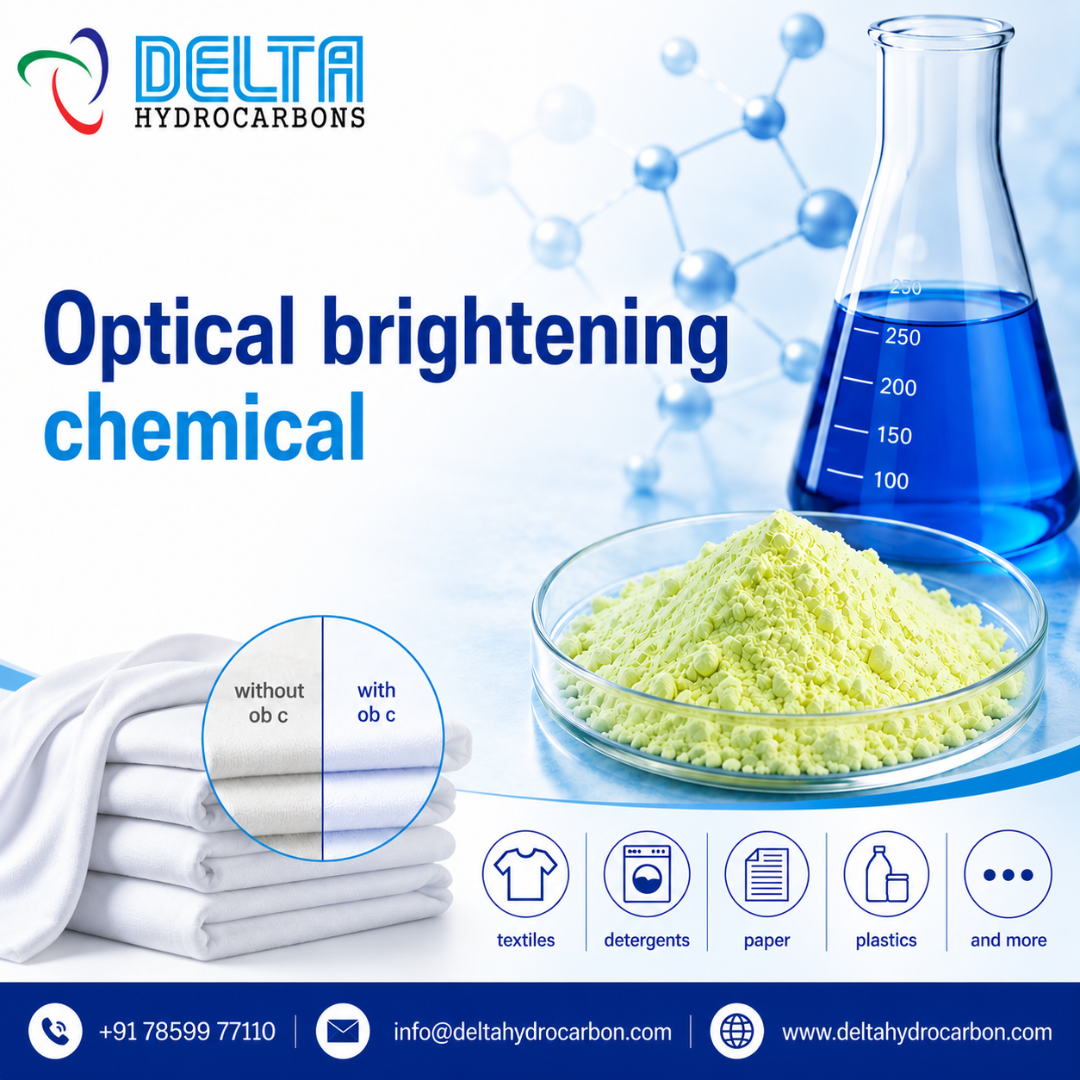
Optical Brightening Chemical – Delta Hydrocarbon
In industries where colour, cleanliness, and surface appearance influence product value, Optical Brightening Chemical plays an important role. These specialised chemicals improve the visual whiteness and brightness of materials by absorbing ultraviolet light and re-emitting it as visible blue light. The result is a cleaner, fresher, and more attractive appearance without changing the basic product structure.
Delta Hydrocarbon supplies quality-focused brightening solutions for industrial applications. Whether you manufacture textiles, paper, detergents, plastics, or coatings, choosing the right Optical Brightening Chemical can help you achieve consistent appearance, improved product appeal, and reliable processing performance.
What Is Optical Brightening Chemical?
An Optical Brightening Chemical is commonly known as an optical brightener, fluorescent whitening agent, or whitening additive. It works by reducing the yellowish tone that can naturally appear in fibres, paper, polymers, and other materials. Instead of bleaching the product, it creates a brighter visual effect through fluorescence.
Different Optical Brightening Agents are formulated for different base materials and process conditions. A suitable grade should be selected based on the application, processing temperature, pH level, compatibility, and desired brightness level.
Key Features of Industrial Brightening Solutions
A high-quality Industrial Optical Brightening Chemical is designed to support stable and uniform results in demanding manufacturing environments. At Delta Hydrocarbon, product selection is approached with attention to performance requirements and end-use suitability.
Important features may include:
- Strong fluorescent whitening effect
- Good compatibility with selected raw materials
- Better dispersion and application consistency
- Resistance to normal processing conditions
- Improved visual brightness with low use levels
- Suitable grades for textile, paper, detergent, plastic, and coating applications
- Reliable batch-to-batch quality for industrial production
The correct product grade and dosage should always be confirmed through trials, technical guidance, and compatibility checks.
Benefits of Using Optical Brightening Chemical
Using Optical Brightening Chemical can offer practical and commercial advantages to manufacturers. It helps improve the perceived quality of finished goods, especially where whiteness and brightness directly affect customer preference.
Better Visual Appeal
Bright-looking products can appear cleaner, newer, and more refined. This is useful for white textiles, printing papers, packaging materials, household products, and plastic goods.
Uniform Product Appearance
When properly selected and applied, brighteners support a more consistent appearance across production batches. Uniformity is especially important for brands that maintain strict visual quality standards.
Enhanced Value Perception
A brighter product surface can improve shelf appeal and customer confidence. For manufacturers, this can help create a better presentation without unnecessarily increasing processing complexity.
Application Flexibility
A carefully chosen Optical Brightening Chemical can be used across several industries. However, the formulation must match the substrate and manufacturing process for the best outcome.
Applications of Optical Brightening Chemical
The application range of Optical Brightening Chemical is broad because many industries require a brighter white tone or improved surface appearance.
Textile Processing
Optical Brightening Agent in Textile applications are widely used for cotton, synthetic fibres, blended fabrics, yarns, and garments. These agents can help fabrics look whiter and more vibrant after dyeing, washing, or finishing. Textile processors should consider fibre type, wash fastness needs, process temperature, and chemical compatibility before selection.
Paper and Packaging
Optical Brightening Chemical for Paper Industry applications help improve the brightness of writing paper, printing paper, tissues, boards, and selected packaging grades. A suitable product can support better print contrast and a cleaner paper appearance. The right grade should be matched with pulp type, fillers, coating systems, and machine conditions.
Detergents and Home-Care Products
Brighteners are also used in detergent formulations to help white fabrics retain a visually bright appearance after washing. The selected grade must be compatible with the detergent base, water conditions, and intended wash cycle.
Plastics, Coatings, and Other Products
Certain grades are used in polymers, paints, coatings, inks, and synthetic materials to reduce yellowish tones and improve brightness. For these uses, heat stability and compatibility with the resin or formulation are important selection factors.
How to Choose the Right Optical Brightening Chemical
Buying a brightening product should involve more than comparing price alone. The best choice depends on your specific production conditions and quality requirements.
Consider these factors before purchase:
Application and substrate: Identify whether the product is for textile, paper, detergent, plastic, or another use.
Processing conditions: Check temperature, pH, water quality, and process duration.
Compatibility: Ensure the brightener works with your existing chemicals, binders, dyes, or resins.
Required performance: Define the desired brightness, whiteness, stability, and durability.
Trial support: Conduct a controlled sample trial before large-scale use.
Supplier reliability: Choose an experienced Optical Brightening Chemical Supplier that can provide product information and practical guidance.
Cost evaluation: Compare the Optical Brightening Chemical Price along with dosage efficiency, consistency, logistics, and technical support.
An experienced Optical Brightening Chemical Manufacturer can help you identify a suitable grade for your process rather than offering a one-size-fits-all product.
Why Choose Delta Hydrocarbon?
Delta Hydrocarbon focuses on supplying industrial chemicals with attention to customer requirements, product suitability, and dependable service. As an Optical Brightening Chemical Supplier, we understand that every application has different technical demands.
Our approach includes:
- Application-oriented product guidance
- Support for product selection and sample evaluation
- Consistent focus on quality and handling requirements
- Solutions for textile, paper, detergent, and industrial uses
- Clear communication for domestic and export requirements
Businesses seeking an Optical Brightening Chemical Expoter should also verify documentation, packaging standards, transport needs, and destination-specific compliance requirements before placing an order.
Frequently Asked Questions
What does Optical Brightening Chemical do?
It improves the visible whiteness and brightness of materials by converting ultraviolet light into visible blue light, helping reduce a yellowish appearance.
Is it the same as bleach?
No. Bleach removes or reduces certain stains and colour compounds, while optical brighteners create a visual brightening effect through fluorescence.
Can it be used in all textiles?
Different fibres require different grades. Cotton, polyester, blends, and other fabrics should be matched with a compatible brightening agent.
How is dosage decided?
Dosage depends on the material, process, desired brightness, and product concentration. Always begin with technical recommendations and controlled trials.
Does a higher dosage always give better brightness?
Not necessarily. Overuse can lead to uneven appearance, waste, or reduced performance. The optimum level should be determined through testing.
What should I check before buying?
Review application suitability, chemical compatibility, technical data, packaging, consistency, support, and the overall Optical Brightening Chemical Price.
Partner with Delta Hydrocarbon
If you need a dependable Optical Brightening Chemical for textiles, paper, detergents, plastics, or other industrial applications, Delta Hydrocarbon can help you evaluate suitable options. Contact our team to discuss your material, process conditions, required brightness level, and quantity requirements. With the right product selection and application guidance, you can achieve consistent, visually appealing results for your finished products.