
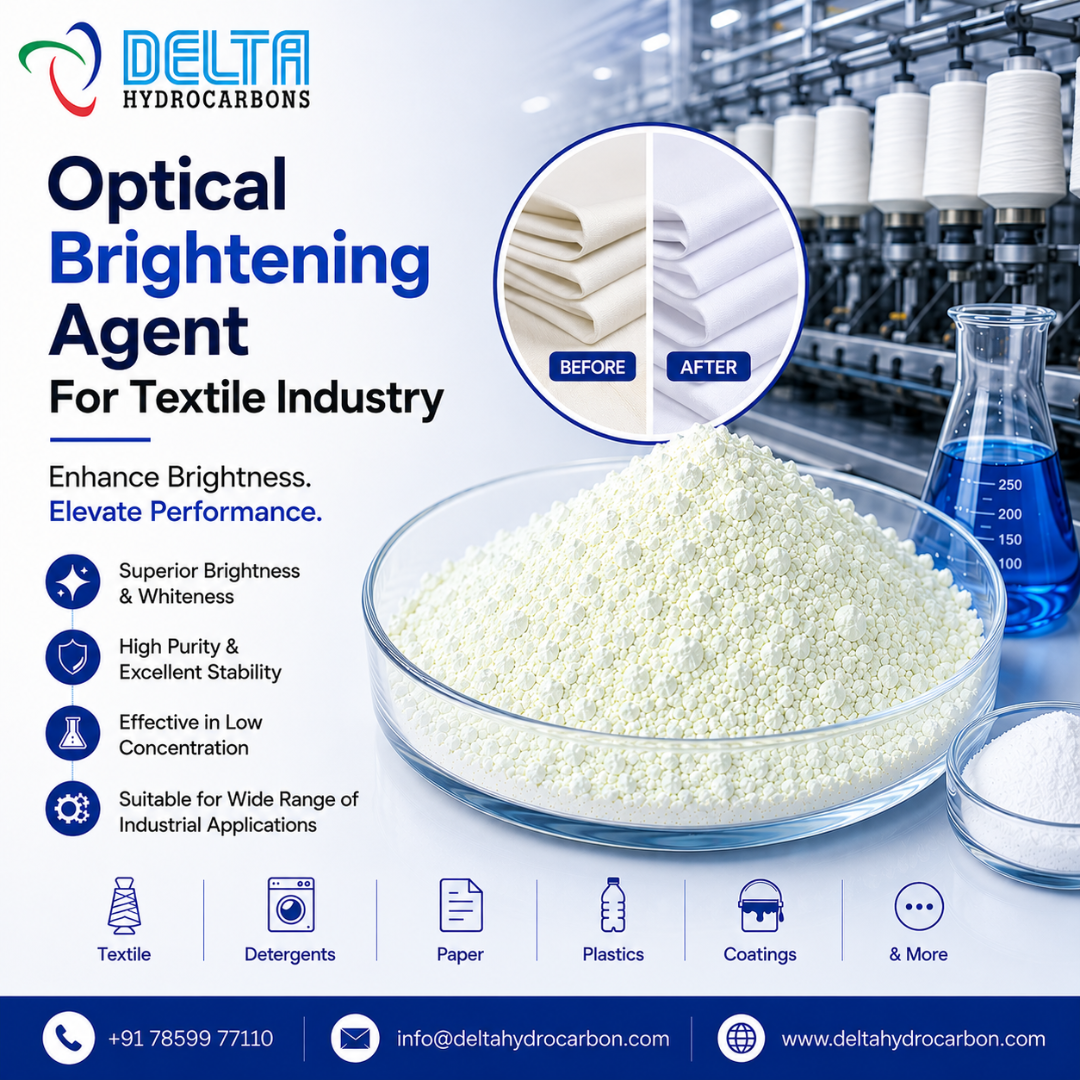
Optical Brightening Agent for Textile Industry – Delta Hydrocarbon
Textile buyers and processors often look for practical ways to improve fabric whiteness, freshness, and visual appeal. An Optical Brightening Agent for Textile Industry is a specialised chemical additive that helps fabrics appear brighter by absorbing ultraviolet light and emitting a bluish visible light. This optical effect reduces the perception of yellow tones and supports a clean, attractive finish.
At Delta Hydrocarbon, we understand that textile finishing requires consistent results, suitable chemical compatibility, and reliable process support. The right Optical Brightening Agent for Textile Industry can enhance the appearance of cotton, polyester, blends, yarns, garments, and home-textile materials when selected and applied correctly.
Understanding an Optical Brightening Agent for Textile Industry
An Optical Brightening Agent is also commonly called an optical whitener or fluorescent brightener. Unlike bleach, it does not remove colour through a strong chemical reaction. Instead, it improves the perceived whiteness and brightness of a textile through fluorescence.
A suitable grade is selected according to fibre type, dyeing method, finishing process, temperature, pH level, and desired shade. For example, cotton and cellulosic fibres may need a different formulation from polyester or poly-cotton blends. Correct selection is essential for stable results and efficient chemical use.
Features That Support Textile Processing
A quality Optical Brightening Agent for Textile Industry is designed to support textile manufacturers in achieving a more uniform and visually pleasing finish. Important features may include:
- Brightening effect for white and light-coloured fabrics
- Suitable solubility or dispersion for the selected process
- Compatibility with commonly used textile auxiliaries
- Support for padding, exhaust, batch, and continuous processes
- Good affinity for specific fibre types
- Improved consistency in fabric appearance
- Options for yarn, fabric, garments, and textile finishing applications
A carefully chosen Fluorescent Brightening Agent for Textile Industry can help reduce uneven brightness while improving the overall presentation of finished textile goods.
Benefits for Fabrics, Yarns, and Garments
The primary benefit of using an Optical Brightening Agent for Textile Industry is improved visual whiteness. Bright white fabric is especially important in shirts, uniforms, bed linen, towels, knitwear, hosiery, and premium home furnishings. A brighter base can also make pastel shades and light colours appear cleaner.
Other benefits include better product appeal, a more consistent finish across batches, and support for customer expectations in appearance-sensitive textile segments. In selected applications, a Optical Whitening Agent for Textile Industry can help maintain a fresh visual look after processing or repeated washing, depending on the fabric, formulation, and care conditions.
It is important to remember that brightness performance is influenced by dosage, water quality, fibre preparation, dye compatibility, and process control. Testing before full-scale production is always a responsible step.
Common Applications in Textile Manufacturing
An Optical Brightening Agent for Textile Industry can be used at different stages of textile production. Textile processors may apply it during bleaching, dyeing, washing, finishing, or garment processing, based on the product grade and manufacturing method.
Cotton and Cellulosic Textiles
Cotton, viscose, rayon, and other cellulosic fibres may use brighteners to create a whiter and clearer appearance. These materials are widely used in apparel, towels, bed sheets, and medical or institutional textiles.
Polyester and Synthetic Fibres
Polyester, nylon, acrylic, and blended fabrics often require heat-stable and fibre-compatible brightener grades. Processing conditions should be carefully reviewed, particularly where high temperatures are involved.
Home Textiles and Finished Garments
Curtains, upholstery fabrics, blankets, bedsheets, towels, and ready-made garments benefit from visual uniformity. A suitable Optical Brightener Chemical for Textile Industry can support a premium-looking finish when used within recommended process limits.
Buying Guide: Choosing the Right Brightener
When sourcing an Optical Brightening Agent for Textile Industry, do not base the decision on price alone. The best choice depends on whether the chemical works effectively with your fibres, machinery, production parameters, and quality expectations.
Before buying, consider the following:
Identify the fibre composition and fabric construction.
Confirm whether the product is for cotton, polyester, blends, or another substrate.
Review the process method: exhaust, padding, printing, washing, or finishing.
Check compatibility with dyes, softeners, binders, resins, and other auxiliaries.
Ask about temperature tolerance, pH suitability, and recommended dosage.
Request a technical data sheet, safety data sheet, and sample for trial.
Evaluate packaging, storage guidance, batch consistency, and technical support.
Businesses searching for Optical Brightening Agent for Sale should choose a product after conducting a small-scale lab or production trial. This helps assess whiteness level, fabric handle, process compatibility, and overall cost efficiency.
Why Work with Delta Hydrocarbon?
Delta Hydrocarbon focuses on helping industrial customers make informed chemical choices for their processes. As an Optical Brightening Agent Supplier for Textile Industry, we encourage buyers to share their fabric type, processing conditions, and brightness requirements before selecting a grade.
If you are evaluating an Optical Brightening Agent Manufcaturer for Textile Industry, look for clear technical communication, product documentation, proper handling guidance, and a commitment to consistent supply. These factors matter because textile results can vary when raw material quality or processing controls change.
For customers managing international procurement requirements, an Optical Brightening Agent Expoter for Textile Industry should also be able to support suitable packaging, documentation, and shipment coordination as required for the destination market.
Frequently Asked Questions
Is an optical brightener the same as bleach?
No. Bleach works by chemically reducing colour or stains, while an optical brightener creates a visual whitening effect through fluorescence.
Can one product be used for all textile fibres?
Not always. Different fibres and process temperatures may require different brightener grades. Fibre-specific selection gives more dependable results.
How much brightener should be used?
Dosage depends on the selected product, fabric weight, process method, and required brightness. Follow technical recommendations and validate them through trials.
Will excess dosage improve whiteness?
No. Too much product may cause uneven results, unwanted shade effects, or unnecessary cost. Controlled dosing is important.
Can brighteners be used in coloured fabrics?
They are typically used for white and light-coloured textiles. Compatibility testing is essential before using them with dyed fabrics.
How should textile brightening chemicals be stored?
Store them in a cool, dry, well-ventilated place away from direct sunlight and moisture. Always follow the safety data sheet and package instructions.
Contact Delta Hydrocarbon for Textile Brightening Solutions
The right Optical Brightening Agent for Textile Industry can help your fabrics achieve a brighter, cleaner, and more consistent appearance. Contact Delta Hydrocarbon today to discuss your textile application, request technical information, and identify a suitable brightening solution for your production process.