
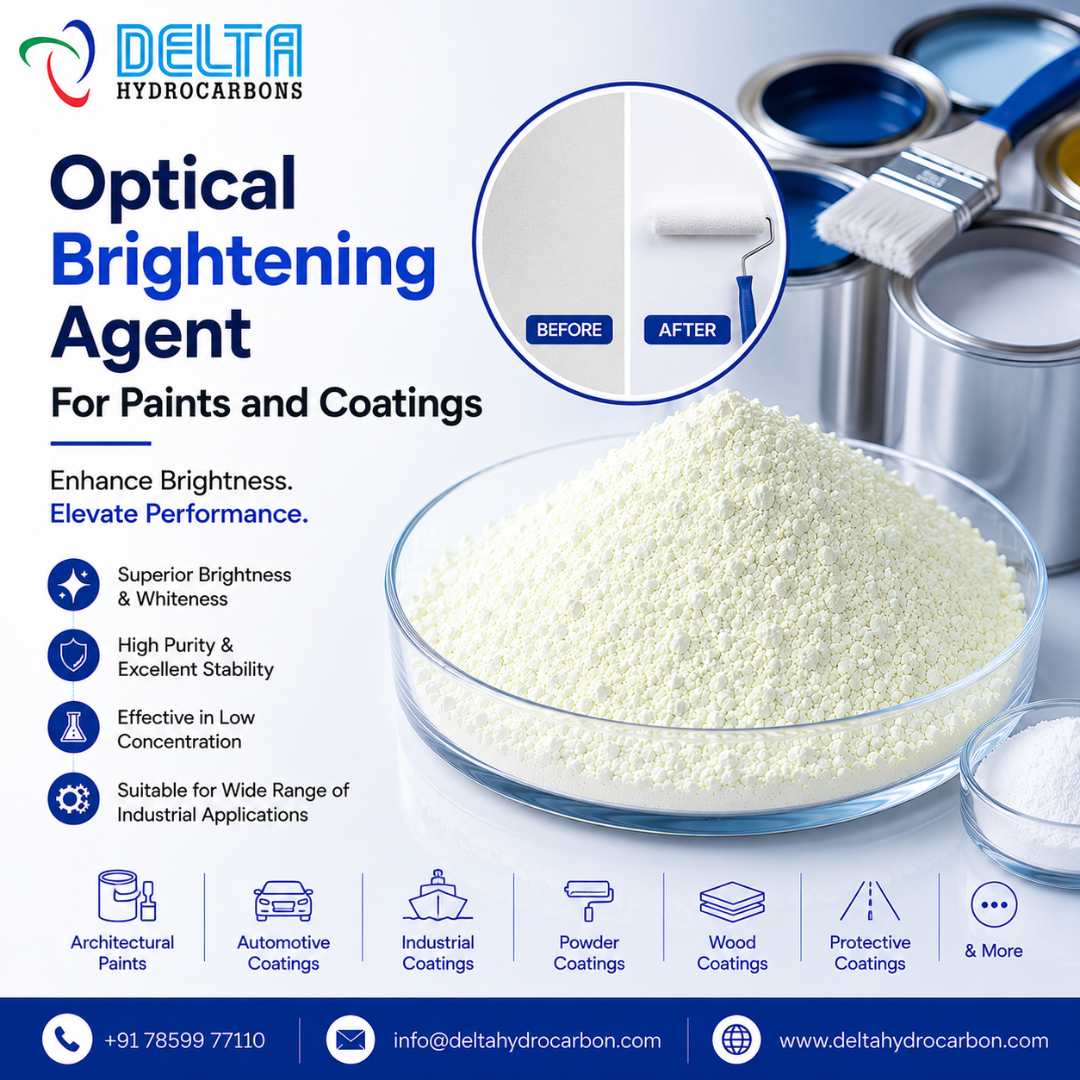
Optical Brightening Agent for Paints and Coatings – Delta Hydrocarbon
Paint and coating manufacturers often need to achieve a clean, bright, visually appealing finish without compromising formulation stability. A suitable Optical Brightening Agent for Paints and Coatings can help enhance the apparent whiteness and brightness of compatible coating systems by reducing dull or yellowish undertones. At Delta Hydrocarbon, we support industrial customers with application-focused brightening solutions for paint and coating formulations.
Selecting an Optical Brightening Agent for Paints and Coatings requires more than choosing a product by colour alone. The material must be compatible with the resin, pigments, solvents or water-based system, processing method, and intended end use. Careful selection and controlled trials help manufacturers achieve reliable, repeatable results.
What Is an Optical Brightening Agent for Paints and Coatings?
An optical brightening agent is a specialty chemical that absorbs ultraviolet light and emits visible blue light. This optical effect can make compatible surfaces appear brighter, cleaner, and less yellow. It is commonly used where white or light-coloured finishes need improved visual brilliance.
An Optical Brightening Agent for Paints may be incorporated into architectural coatings, industrial paints, primers, decorative finishes, and selected specialty formulations. Similarly, an Optical Brightening Agent for Coatings can be useful in protective coatings, packaging coatings, wood coatings, and other systems where appearance is important.
The final performance depends on the formulation and use conditions. Factors such as pigment selection, resin type, film thickness, light exposure, and additive compatibility should always be considered before commercial-scale production.
Why Use an Optical Brightening Agent for Paints and Coatings?
The right Optical Brightening Agent for Paints and Coatings can provide a noticeable visual advantage in products where brightness, whiteness, and surface presentation influence customer perception. It is especially useful for manufacturers working with white, pastel, clear, or light-coloured coating systems.
Enhanced Visual Brightness
Optical brighteners can help create a more vivid and cleaner-looking finish. They may reduce the perception of yellowish tones in a compatible formulation, making white and light shades appear more attractive.
Better Finish Consistency
When properly dispersed and dosed, an Optical Brightening Agent can support more consistent visual brightness from batch to batch. This can be valuable for manufacturers supplying decorative paints, industrial coatings, and branded consumer products.
Support for Premium-Looking Products
A bright, fresh coating surface can improve the perceived quality of the finished product. This matters in applications such as interior wall paints, appliance coatings, consumer packaging, plastic coatings, and furniture finishes.
Flexible Use in Suitable Systems
Depending on the grade, brightening agents may be used in water-based or solvent-based systems. However, compatibility testing is essential because every resin and pigment combination behaves differently.
Key Features to Look for in a Brightening Agent
At Delta Hydrocarbon, we recommend evaluating a product on technical suitability rather than choosing only by appearance or cost. A quality Optical Brightening Agent for Paints and Coatings should be assessed against the requirements of the actual formulation.
Important features include:
- Effective brightness enhancement in compatible coating systems
- Good dispersibility in the selected medium
- Suitable compatibility with resin, pigment, and additive packages
- Stable performance under appropriate processing conditions
- Low impact on the intended shade and gloss
- Support for uniform, clean-looking surface finishes
- Availability of technical product information and handling guidance
An appropriate Optical Brightening Chemical For Paints should be evaluated through controlled laboratory and production trials before large-volume use.
Applications in Paints and Coatings
An Optical Brightening Agent for Paints and Coatings may be selected for a variety of industrial and decorative applications. Its purpose is usually to improve the appearance of white or light-coloured surfaces rather than replace pigments or colourants.
Architectural Paints
Interior emulsions, exterior coatings, primers, and decorative paints may use brightening agents to help create a fresher-looking white finish. The selected grade must remain compatible with the binder and other formulation components.
Industrial and Protective Coatings
Metal coatings, machinery finishes, equipment coatings, and selected protective systems may benefit from improved visual brightness. Product selection should consider curing temperature, exposure conditions, and coating thickness.
Wood and Furniture Coatings
Light-coloured wood finishes, clear coats, laminates, and furniture coatings can use suitable brightening solutions to enhance surface appeal. A Fluorescent Whitening Agent For Coatings should be checked for its effect on transparency, gloss, and long-term appearance.
Packaging and Specialty Coatings
Brightening agents may also be used in certain packaging, paper-coating, and speciality surface applications where a clean white appearance supports product presentation.
Buying Guide: How to Select the Right Product
Choosing the Best Optical Brightening Agent for Paints and Coatings starts with understanding your specific formulation and performance needs. The following checklist can help make procurement more informed:
Identify your coating type: Specify whether your system is water-based, solvent-based, powder coating, UV-curable, or another format.
Confirm resin compatibility: Check suitability with acrylic, alkyd, polyurethane, epoxy, vinyl, or other resin systems.
Review pigment interaction: Some pigments and fillers can affect brightness, shade, or dispersion quality.
Test dosage levels: More additive does not always mean better performance. Use trials to determine a suitable dosage range.
Check processing stability: Consider mixing, grinding, curing, drying, and application conditions.
Assess end-use exposure: Evaluate light exposure, heat, moisture, and surface-wear requirements.
Compare overall value: When reviewing Optical Bbrightening Agent Price For Paints, consider dosage efficiency, consistency, technical support, and expected finish quality—not only the purchase price.
A knowledgeable Optical Brightening Agent Supplier for Paints and Coatings can help you narrow down suitable options and plan effective trials.
Why Choose Delta Hydrocarbon?
Delta Hydrocarbon focuses on practical, application-oriented support for customers seeking specialty chemicals for industrial formulations. We understand that a brightening agent must fit into a complete paint or coating system, not simply perform well in isolation.
Our approach includes:
- Clear product discussions based on your application requirements
- Support for sample evaluation and formulation trials
- Attention to consistent supply and appropriate packaging
- Guidance on handling, storage, and product-use considerations
- Responsive support for industrial and bulk requirements
As an Optical Brightening Agent Expoter for Paints and Coatings, Delta Hydrocarbon works with customers requiring dependable coordination for supply requirements across suitable domestic and export markets.
Frequently Asked Questions
What does an optical brightening agent do in paint?
It helps compatible white or light-coloured paint systems appear brighter by reducing the visual effect of yellowish undertones.
Can it be used in water-based paints?
Some grades may be suitable for water-based formulations. Compatibility with the binder, additives, and pigments must be verified through testing.
Will a brightening agent replace titanium dioxide?
No. Brightening agents and white pigments serve different functions. A brightening agent can enhance visual brightness, while titanium dioxide provides opacity and whiteness.
How much brightening agent should be added?
The right dosage depends on the formulation. Start with controlled laboratory trials and follow product-specific guidance.
Can it affect gloss or colour shade?
It can, depending on the coating composition and dosage. Testing is important to confirm the desired finish, shade, and gloss level.
How should the product be stored?
Store it according to the product’s technical and safety documentation, generally in a cool, dry place away from moisture and direct sunlight.
Partner with Delta Hydrocarbon
If you are looking for a dependable Optical Brightening Agent for Paints and Coatings, Delta Hydrocarbon is ready to support your formulation needs. Share details about your coating system, resin type, shade requirement, production process, and expected order quantity. Our team can help you identify a suitable solution for brighter, more consistent, and visually appealing paint and coating finishes.