
Industrial Optical Brightening Agent – Delta Hydrocarbon
In paper, textile, plastic, detergent, and packaging production, visual brightness strongly influences product appeal and perceived quality. An Industrial Optical Brightening Agent is formulated to improve whiteness and create a cleaner, brighter appearance in finished materials. Delta Hydrocarbon supplies dependable brightening solutions designed for industrial processes where consistency, compatibility, and controlled application matter.
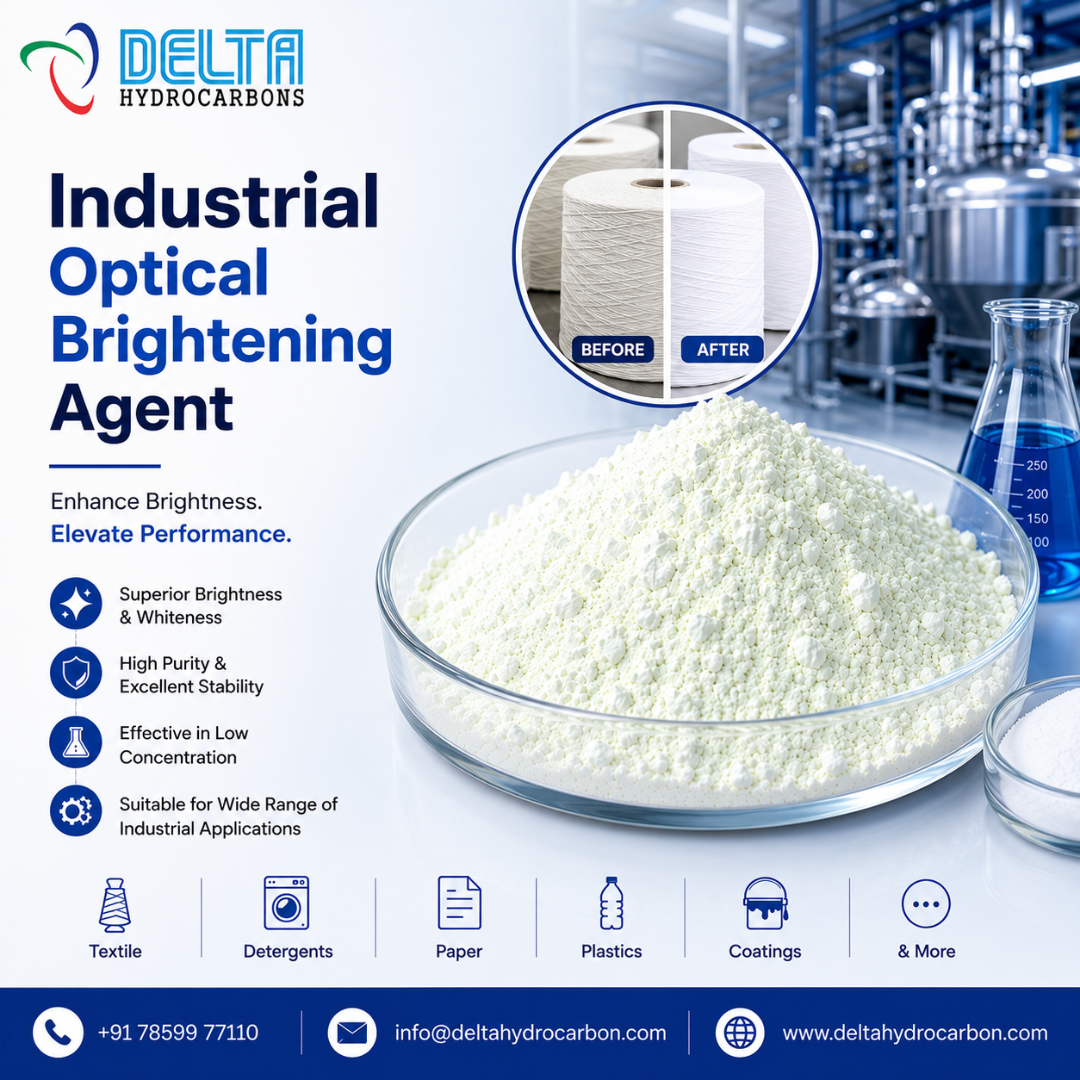
An Industrial Optical Brightening Agent works by absorbing invisible ultraviolet light and releasing it as visible blue light. This optical effect helps reduce the yellowish tone that can appear in substrates, making products look brighter and fresher. It does not simply cover dullness; it enhances the way the surface reflects light when used at the correct dosage.
What Is an Industrial Optical Brightening Agent?
An Industrial Optical Brightening Agent is a specialty chemical commonly known as an Optical Brightening Agent or fluorescent brightener. It is added during manufacturing to improve the apparent whiteness and brightness of various materials. Depending on the application, it may be supplied as a powder, liquid, dispersion, or granule.
The correct grade depends on the base material, production temperature, processing method, and required level of brightness. For example, a brightener selected for paper may not be the right choice for plastic or textiles. This is why manufacturers should assess technical suitability before making a bulk purchase.
Key Features of an Industrial Optical Brightening Agent
A quality Industrial Optical Brightening Agent can support efficient, consistent production when it is selected and used properly. Important features include:
- High brightening efficiency at controlled dosages
- Good compatibility with suitable polymers, fibers, coatings, or paper pulp
- Stable performance during the intended processing conditions
- Improved visual whiteness with a balanced bluish tone
- Uniform dispersion when handled according to product guidance
- Availability in grades tailored to different industrial requirements
Delta Hydrocarbon focuses on supplying products with clear specifications and practical application support. Testing a sample under actual production conditions remains the most reliable way to confirm performance.
Benefits for Industrial Production
Using an Industrial Optical Brightening Agent can help manufacturers improve the visual quality of products without changing their essential function. A brighter product can make white paper appear cleaner, fabrics look more vivid, plastic articles appear fresher, and detergent formulations support a brighter-looking wash result.
Other benefits may include better batch appearance, improved product presentation, enhanced whiteness in recycled or slightly yellow-toned materials, and greater flexibility in achieving a desired shade. The Best Optical Brightening Agent for a business is not necessarily the one with the highest brightness value alone; it should also suit the specific substrate, process, and compliance needs.
A well-matched grade helps prevent concerns such as uneven appearance, excessive blue tone, poor dispersion, or reduced performance after processing. Careful selection supports more predictable results across production batches.
Applications Across Industries
The versatility of an Industrial Optical Brightening Agent makes it useful in several manufacturing sectors.
Paper and Packaging
In paper manufacturing, brighteners can improve the visual whiteness of writing paper, packaging board, tissue, and coated paper products. They are often considered when producers want a clean, premium-looking finish. Compatibility with pulp, fillers, coating systems, and process water should be reviewed before use.
Textile Processing
Textile producers use suitable brighteners for cotton, polyester, blended fabrics, yarns, and other fibers. The right grade can improve the brightness of white textiles and support a clearer visual base before dyeing or finishing. Wash fastness, heat stability, and fiber affinity are important selection factors.
Plastics and Polymers
Plastic processors may use brighteners in products such as molded goods, films, sheets, household articles, and packaging components. A compatible brightener can help counter mild yellowing and improve the appearance of white or light-coloured polymer products. Processing temperature and polymer type must be checked carefully.
Detergents and Cleaning Products
Certain brighteners are used in detergent and cleaning formulations to support a brighter-looking fabric surface after washing. The formulation should be evaluated for solubility, stability, and compatibility with surfactants and other ingredients.
Choosing the Right Grade: A Practical Buying Guide
When comparing an Industrial Optical Brightening Agent Supplier, buyers should look beyond price. A technically appropriate product can help reduce production trials, material wastage, and consistency issues.
Consider these points before ordering:
Identify the exact application, such as paper, textile, plastic, or detergent.
Confirm the substrate and processing conditions, including heat, pH, and mixing method.
Request technical data, recommended dosage, storage guidance, and safety documentation.
Evaluate sample performance in your own production environment.
Check batch consistency, packaging quality, supply capability, and delivery timelines.
Discuss required whiteness level rather than assuming more dosage will deliver better results.
As an Industrial Optical Brightening Agent Manufacturer, a responsible supplier should help customers understand product handling and suitability. For businesses seeking an Industrial Optical Brightening Agent in Ahmedabad, local technical communication and reliable logistics can also make procurement easier.
Why Choose Delta Hydrocarbon?
Delta Hydrocarbon understands that industrial buyers need more than a product name on a quotation. They need clear information, stable quality, responsive coordination, and a brightener grade that aligns with their manufacturing process. Whether you are evaluating a new formulation or improving an existing product line, the right technical discussion can make a meaningful difference.
Customers looking for a Top Optical Brightening Agent should compare application fit, documentation, performance testing, and supply reliability together. Delta Hydrocarbon aims to support these decisions with a practical, customer-focused approach.
For customers requiring export-oriented supply, an Industrial Optical Brightening Agent Expoter should also be able to provide appropriate packaging, documentation, and coordination based on destination requirements. These details should always be confirmed before finalising an international order.
Frequently Asked Questions
Is an Industrial Optical Brightening Agent suitable for every material?
No. Different grades are designed for different substrates and processing systems. Always select a product after reviewing the application requirements and conducting a trial.
How much brightener should be used?
Dosage varies by product grade, substrate, desired brightness, and process conditions. Start with supplier-recommended levels and optimise through controlled testing.
Can excessive dosage create problems?
Yes. Too much brightener may create an overly bluish appearance, uneven results, unnecessary cost, or compatibility concerns. Accurate dosing is important.
Who commonly uses these products?
Industrial Optical Brightening Agent Users include paper mills, textile processors, plastic manufacturers, detergent formulators, packaging producers, and related industrial businesses.
Partner with Delta Hydrocarbon
If your business needs a reliable Industrial Optical Brightening Agent, connect with Delta Hydrocarbon for product information, technical guidance, and application-focused support. Share your material type, process conditions, and brightness objective so the team can help you evaluate a suitable solution. A careful selection today can support cleaner appearance, consistent output, and confident production planning.